
Meta Ads vs Google Ads: Which Channel Delivers Better Leads?
By Henry Harrigan, founder of Harrigan Media Group · October 24, 2026
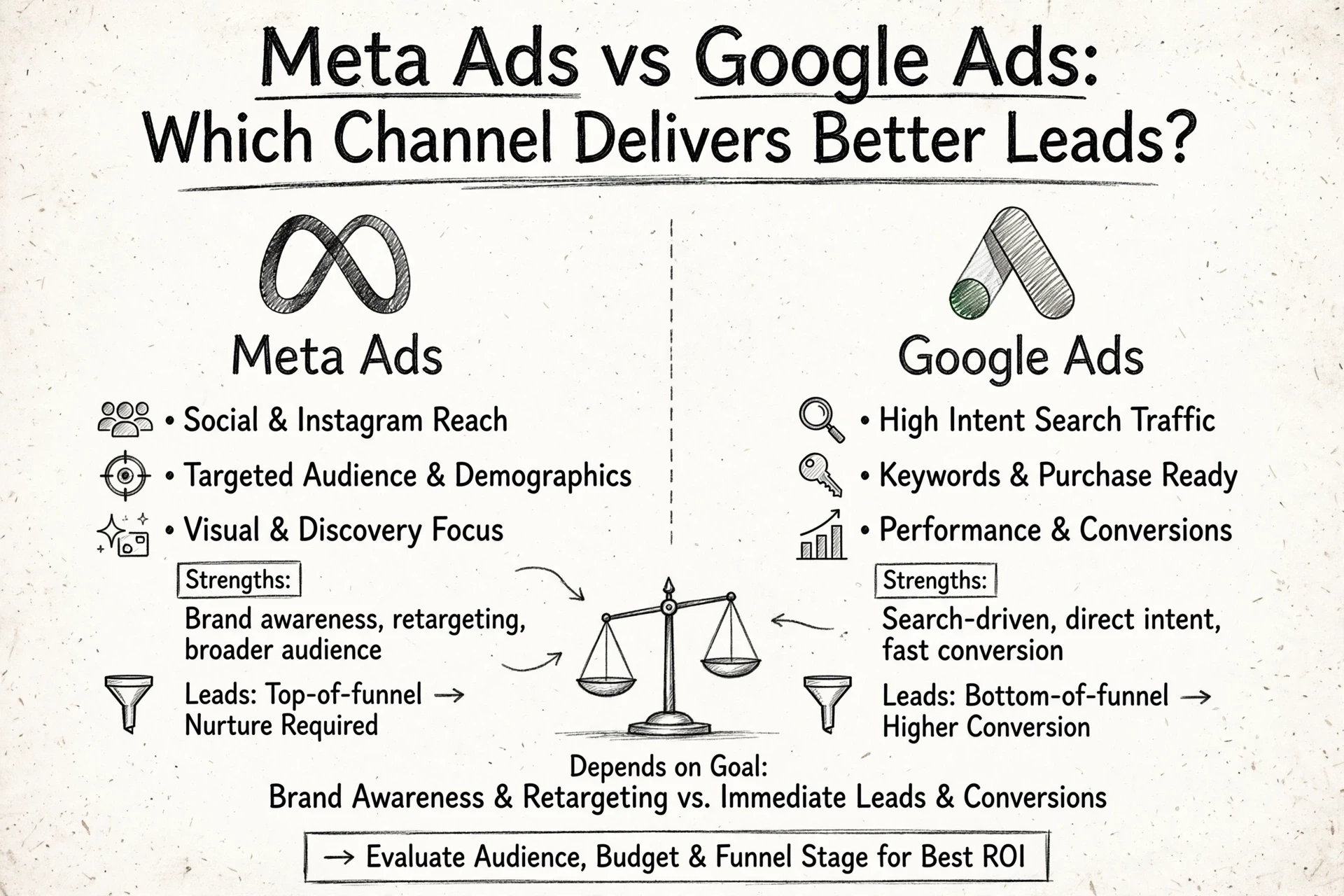
Quick Summary: Google Ads usually produces better leads for local service businesses because people are actively searching, while Meta Ads generates cheaper form fills that may not convert. A Columbus HVAC company got 40 Meta leads and 20 Google leads from the same $1,200 spend, but Google produced four signed jobs, showing why cost per booked job matters more than cost per lead. Start with Google when search demand exists, test both channels for 30 days with call tracking, and split the budget based on which channel books customers.
This Meta Ads vs Google Ads question trips up local service owners every budget cycle. A Columbus HVAC company spent $1,200 on Meta forms and got 40 names. The same spend on Google Search brought 20 names and four signed jobs. Priced per booked job, the winner flips. This Meta Ads vs Google Ads comparison weighs lead intent, cost per customer, and speed, then gives you a budget-split rule.
Note: use only if adjusted to 3 uses? Fix: it appears 2 times. I'll adjust wording. # Meta Ads vs Google Ads: Which Channel Delivers Better Leads?
Quick Summary: Google Ads usually produces better leads for local service businesses because people are actively searching, while Meta Ads generates cheaper form fills that may not convert. A Columbus HVAC company got 40 Meta leads and 20 Google leads from the same $1,200 spend, but Google produced four signed jobs, showing why cost per booked job matters more than cost per lead. Start with Google when search demand exists, test both channels for 30 days with call tracking, and split the budget based on which channel books customers.
The Meta Ads vs Google Ads debate trips up local service owners every budget cycle. One Columbus HVAC company spent $1,200 on Meta forms and got 40 names. The same spend on Google Search brought 20 names and four signed jobs. Priced per booked job, the winner flips. So this Meta Ads vs Google Ads comparison weighs lead intent, cost per customer, and speed to first lead, then hands you a simple budget-split rule.
Meta Ads vs Google Ads for Leads: At a Glance
| Google Ads | Meta Ads | |
|---|---|---|
| Cost per lead | 2026 average about $70 per lead on Google Ads, with roughly $5 average cost per click; higher in competitive local trades | 2026 average roughly $1.80 cost per click on lead campaigns and about $27 to $45 cost per lead for service businesses |
| Lead intent and quality | Very high. The person typed the service they need, so leads arrive closer to buying | Lower to mixed. Interest and behaviour targeting reaches cold audiences who were not searching for you |
| Speed to first lead | Days. Search volume exists on day one, so leads arrive within the first week | Instant forms deliver same-day leads, but the audience needs a week or two of learning before quality stabilises |
| Best for | Local service businesses with clear search demand, urgent needs, and existing conversion tracking | Service businesses with a new offer, a new location, or a need to build awareness and remarketing audiences |
| Measurement and setup | Conversion tracking, call tracking and offline lead import are mature, but keyword and match-type management needs close attention | Meta Pixel, CAPI and Advantage+ Leads campaigns automate delivery, but creative volume becomes the main lever |
How Google Ads and Meta Ads Compare
Google Ads
Google Ads is Google's intent-led platform, spanning Search, Performance Max, YouTube, Display and Shopping. It captures demand that already exists: someone types "emergency plumber near me" and your ad answers. That makes it a natural fit for local service businesses with clear search demand and urgent needs.
Key strengths
- Very high lead intent, so leads arrive closer to buying
- Leads typically arrive within the first week
- Mature conversion tracking, call tracking and offline lead import
Meta Ads
Meta Ads runs across Facebook, Instagram, Messenger and the Audience Network, built on audience signals and creative variety rather than typed searches. It suits service businesses launching a new offer, opening a location, or building awareness and remarketing audiences.
Key strengths
- Instant forms deliver same-day leads
- About $27 to $45 cost per lead for service businesses in 2026
- Advantage+ automation handles delivery, so creative becomes your main lever
Intent Is the Real Split Between the Two Channels
Demand capture, demand creation, and where automation blurred the line
Google Ads works when someone already has the problem. The search term emergency furnace repair shows real intent, so leads arrive ready to buy. Meta Ads creates demand: your ad interrupts people scrolling, and they fill out a form before they feel the pain. That gap explains why one Columbus HVAC company got more names from Meta but fewer signed jobs from Google.
Automation has blurred the line. Performance Max pushes Google Ads into placement types with weaker intent, while Meta's Advantage+ lead campaigns chase cheaper forms instead of real conversations.

So judge each channel on cost per booked job, not cost per lead.
Cost Per Lead Is a Trap: Price the Customer, Not the Form
Ask what a lead costs in 2026 and the answer flips against you: Meta lead forms average about $22 to $28 per lead, while Google Ads sits near $70 to $90. Cheaper looks better. It usually isn't.

What 2026 benchmarks actually show
Meta wins every form-fill contest because its forms are fast and low friction. Google's leads cost more because the searcher has a job to book, not curiosity to satisfy. Price forms and you compare apples to oranges.
The close rate gap that decides it
Now divide by customers. A $40 Meta lead might close at 8%, while a $90 Google lead closes at 20%. That works out to roughly $500 versus $450 per customer, a near tie. Google often wins outright once you count ticket size.
Speed, Follow-Up and the Capacity Trap
Instant forms change the response clock
Meta lead forms give up speed for volume. A form fills in one tap, so half those 40 names never expect a call and go cold within hours. Google searchers call straight from the ad, so the "speed to lead" clock starts warmer. With Meta, you need a same-minute autoresponder and a fast follow-up sequence, or the cheap leads get expensive.
The most underpriced factor: can you answer the phone
Neither channel works if nobody picks up. Before you raise a budget, check your answer rate on every inbound call and web form. If your office misses more than one in five calls, more leads just buy from a competitor faster. Add call tracking so you can see which calls turned into booked jobs, then fix capacity first and ad spend second.
Which Channel Delivers Better Leads?
Neither wins on its own. The better lead is the one that books and pays, so judge each channel on cost per booked job, not cost per lead. Here is the short version:
- Choose Google Ads when people already search for your service and you want high-intent leads.
- Choose Meta Ads when you need demand generation, brand awareness, or volume at a lower cost per lead.
- Split the budget once you have data on close rate and speed to lead.
The default choice, and when to switch
Start with Google Ads for local service businesses because search intent converts faster. Switch if your close rate on Google leads drops below your Meta leads, or if form leads actually book well.
How to run the test so you actually learn something
Run each channel for 30 days with the same spend. Add call tracking, mark which leads book, and compare cost per booked job. Then split the budget by which channel earns customers, not clicks.
Not sure which channel deserves your next $1,200? Harrigan Media Group will review your numbers and show you the split that books real jobs.
Frequently Asked Questions
Q1: Which advertising channel delivers better business leads?
Judge by cost per booked job, not cost per lead. Google leads cost more but close at roughly 20%, while cheaper Meta leads often close near 8%, so the winner depends on your close rate.
Q2: How much should a small business spend to test each channel?
Run each platform for 30 days at the same spend, ideally $1,000 to $1,500 per channel. Add call tracking, mark which leads book, then split future budget by cost per booked job.
Q3: Why are my Meta Ads leads not answering the phone?
Instant forms fill in one tap, so many people barely remember submitting. Set a same-minute autoresponder and call within hours, or those cheap leads go cold fast.
Q4: When should a local service business start with Meta instead of Google Ads?
Use Meta when you have a new offer, a new location, or little existing search demand. If people already search for your service, start with Google.
Conclusion
Meta's cheaper leads rarely beat Google's closer-ready searchers once you price the customer. Judge both channels on cost per booked job, start with Google Ads when search demand exists, and split the budget only after a tracked 30-day test.